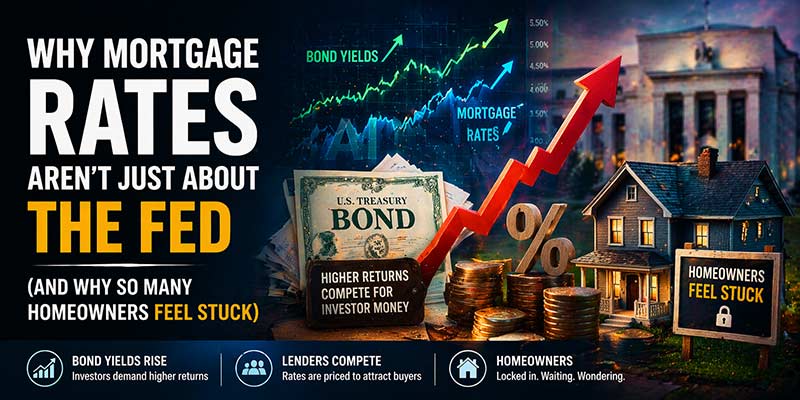
Why Mortgage Rates Aren’t Just About the Fed (And Why So Many Homeowners Feel Stuck)
A lot of people think mortgage rates are controlled by the Federal Reserve. They’re not. The Fed influences rates—but it doesn’t directly decide what your mortgage rate is going to be. And that’s where a lot of the confusion comes from.
Mortgage rates are heavily tied to the bond market—but not in a passive way. Lenders are actively pricing loans to compete for investor money. When a mortgage is created, it’s usually not held by the lender long-term. It gets packaged into a mortgage-backed security and sold. That means the lender has to make that loan attractive enough for someone else to buy.
And investors aren’t just choosing between mortgages and nothing—they have options. Government bonds, corporate bonds, stocks, and other investments are all competing for the same money. So if those alternatives start offering better returns, mortgage-backed securities have to keep up. And the only way to do that is by increasing the return those loans generate—which means higher interest rates for borrowers.
It’s not automatic. It’s a choice. Lenders are constantly adjusting rates to stay competitive in a broader marketplace where capital flows to whatever offers the best balance of risk and return. If they don’t, investors take their money elsewhere—and the system stops working.
The Fed still matters—but more behind the scenes. When the Fed raises or lowers rates, it affects the overall economy. One of the biggest things it impacts is inflation. And inflation is a big deal when it comes to mortgage rates. If inflation is high, lenders and investors want higher returns to make up for the fact that money will be worth less in the future. That pushes mortgage rates higher.
That’s why sometimes you’ll hear the Fed “paused” or even “cut rates,” but mortgage rates don’t really move much. They’re reacting to a bigger picture.
Now here’s where this really hits home for a lot of people. A huge number of homeowners locked in rates in the 2–3% range over the past few years. Those are incredibly low rates.
So now imagine this: you have a 3% mortgage. You’re thinking about moving. But today’s rates are closer to 6.5% or 7%. Even if you buy a similar-priced home, your monthly payment could jump significantly.
That’s what makes people feel stuck. It’s not that they can’t move. It’s that moving feels like taking a step backward financially.
And when a lot of homeowners feel that way at the same time, fewer people sell. That means less inventory on the market. And when inventory stays low, prices don’t drop the way people expect—even when rates are higher.
But being “stuck” isn’t always as black-and-white as it feels. Sometimes moving still makes sense. Life changes. Jobs change. Families grow. Priorities shift. And in some cases, the decision isn’t just about the interest rate—it’s about the bigger picture.
There are also different ways people approach it. Some keep their current home and turn it into a rental. Others look into ways to reduce their rate on a new purchase. Some use their equity to offset the higher cost of borrowing. There’s no one perfect solution—it depends on the situation.
The main thing to understand is this: mortgage rates aren’t controlled by one single thing, and they don’t always move the way people expect.
So waiting for the “perfect time” based on headlines alone doesn’t always work. The people who make the best decisions in this kind of market are the ones who understand how the pieces fit together—and make a move when it makes sense for them.
Because in today’s market, understanding what’s really going on isn’t just helpful. It can save you from making the wrong move—or missing the right one.